By Sergio M. Alarcón
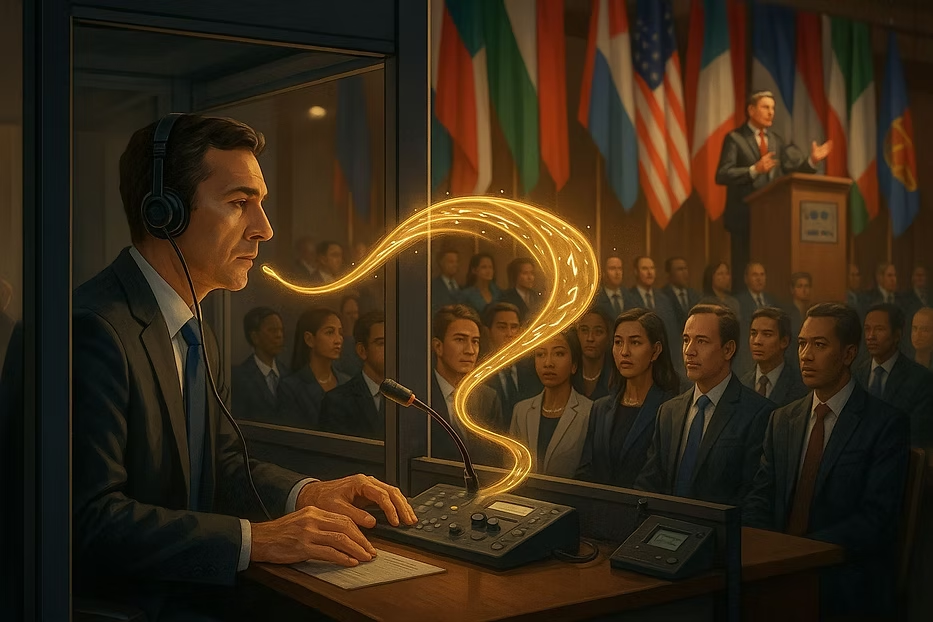
Artificial Intelligence has moved from being a future promise to becoming a daily presence in our work as interpreters. Denying it would be naïve; embracing it without questioning it would be dangerous. As with any powerful tool, AI amplifies both our strengths and our vulnerabilities.
From my professional experience, I would like to share some clear advantages, as well as very real disadvantages that deserve an honest discussion.
Advantages of AI in Interpretation
1. Faster and deeper terminological preparation AI has transformed pre-assignment preparation. Today, we can generate specialized glossaries in minutes, including multilingual equivalents, usage context, and regional variants. This is particularly valuable in technical, medical, sports, or legal conferences, where preparation time is often limited.
2. Immediate access to reference articles and background materials The ability to summarize, analyze, and cross-reference academic articles, previous presentations, and technical documents allows interpreters to enter the booth with a stronger conceptual understanding of the subject, not just a list of terms.
3. Advanced translation of working documents AI facilitates preliminary translation of Word, PDF, and Excel documents, which can then be used as support material during interpretation: agendas, presentations, technical charts, statistics, and written speeches. When used properly, this saves hours of mechanical work and frees cognitive energy for what truly matters: the act of interpretation itself.
4. Support during interpretation Digital glossaries, quick searches, and intelligent note-taking can turn AI into a silent assistant, especially in remote or hybrid interpreting settings.
Up to this point, the story sounds like progress.
The real issue arises when the same tools that help us work better are used to replace us or introduce new professional risks.
When advantages turn into disadvantages
1. Voice cloning and learning from our own interpretations Every online interpretation, every stored recording, becomes training material for AI models. Our voice, intonation, personal style, and decision-making processes can be replicated without explicit consent.
What today is described as “technological support” may tomorrow become a clone trained on our own work.
2. Loss of control over intellectual property Interpretation was traditionally ephemeral. Today, it is no longer so. It is recorded, indexed, processed, and reused. Without clear legal frameworks, interpreters risk losing control over the professional capital built over decades.
3. Localization and “tropicalization” issues Many AI platforms, especially when working into Spanish, provide translations that are poorly localized. They often default to Peninsular Spanish or, in some cases, Rioplatense (Argentine) Spanish.
This creates serious problems when working for Latin American or Mexican Spanish, where:
- Terminology differs
- Register and institutional tone change
- Cultural connotations are not the same
In interpretation, these nuances are not cosmetic — they are critical to message accuracy. Poor localization can undermine clarity, damage the speaker’s credibility, and even affect the outcome of negotiations or official events.
4. Homogenization of discourse AI tends to average, flatten, and normalize language. Human interpretation, by contrast, recognizes silence, irony, cultural subtext, political intent, and emotional tension. When efficiency is prioritized above all else, communicative depth is lost.
5. Devaluation of the professional role The narrative that “AI does it almost as well” pushes fees downward, shortens recognized preparation time, and reduces interpreters to technical operators, when in reality they are cultural, strategic, and ethical mediators.
Final reflection
The question is no longer whether AI is here to stay. That has already been answered. The real question is under what conditions.
As interpreters, we must:
- Use AI intelligently and critically.
- Demand clear rules regarding recording, voice use, and data ownership.
- Defend proper linguistic and cultural localization.
- Protect the human value of interpretation: judgment, ethics, culture, and responsibility.
AI can be a powerful ally. But only if we remain the owners of our voice, our judgment, and our profession.

Sergio is a chemical microbiologist, licensed interpreter, and the founding president of Colegio Mexicano de Intérpretes de Conferencias.
Click on the WhatsApp icon below and talk to us to help us understand your needs for efficient communications solutions. No sales pitch! Just a free consultation call.